
Pennsylvania specific loss benefits pay a fixed number of weeks of compensation when a work injury causes the permanent loss of a body part, or the permanent loss of its use, along with certain hearing loss and disfigurement. You do not have to lose any wages to qualify. For 2026 injuries, the weekly rate ranges from $697 to $1,394, multiplied by the weeks the law assigns to the body part.
Most workers’ compensation benefits replace lost wages. Specific loss benefits work differently. They compensate you for a permanent injury itself, which means a worker who lost the use of a hand can collect hundreds of thousands of dollars even after returning to full-time work.
Insurance companies know how valuable these claims are, and they often argue that a worker has only partial use left rather than a true loss of use. Understanding how Pennsylvania defines and pays specific loss helps you recognize when an offer is too low. For a broader look at wage-loss rates, see our guide to how much you get paid on workers’ comp.
What Are Specific Loss Benefits in Pennsylvania?
Specific loss benefits come from Section 306(c) of the Pennsylvania Workers’ Compensation Act, found at 77 P.S. § 513. The law lists body parts and assigns each one a set number of weeks of compensation. A worker qualifies in one of four main ways:
- Amputation. The physical loss of a body part, whether at the scene or through later surgery.
- Permanent loss of use. The body part is still attached but no longer works for any practical purpose.
- Hearing loss. Permanent occupational hearing loss, measured by audiogram.
- Serious and permanent disfigurement. Scarring of the head, neck, or face that produces an unsightly appearance.
Loss of Use: The Most Disputed Part of Specific Loss Claims
The Act states that permanently losing the use of a hand, arm, foot, leg, eye, finger, thumb, or toe counts the same as losing the body part itself. Pennsylvania courts apply a demanding standard: the worker must show the body part has been permanently lost for all practical intents and purposes.
That standard does not require the body part to be completely useless. It does require more than weakness, pain, or limited motion. A hand that can still grip and work with some difficulty usually does not qualify, while a hand with severe nerve damage that the worker can no longer rely on for daily tasks may.
These claims usually come down to medical opinions. Your treating doctor’s description of what the body part can and cannot do carries significant weight, and the insurer will often send you to an independent medical examination to dispute it. Detailed records about function, not just diagnoses, make the difference.
Fingers and toes follow special rules. Losing part of the first bone of a finger or thumb counts as losing half of it, and losing more than that counts as losing the entire digit.
The Pennsylvania Specific Loss Schedule
The table below lists the weeks of compensation assigned to each body part under Section 306(c), along with the maximum healing period that applies.
| Body Part Lost or Lost Use Of | Weeks of Specific Loss Benefits | Maximum Healing Period |
|---|---|---|
| Arm (at or above the elbow) | 410 weeks | 20 weeks |
| Leg (at or above the knee) | 410 weeks | 25 weeks |
| Forearm (between wrist and elbow) | 370 weeks | 20 weeks |
| Lower leg (between ankle and knee) | 350 weeks | 25 weeks |
| Hand | 335 weeks | 20 weeks |
| Eye | 275 weeks | 10 weeks |
| Foot | 250 weeks | 25 weeks |
| Thumb | 100 weeks | 10 weeks |
| Index finger | 50 weeks | 6 weeks |
| Second finger | 40 weeks | 6 weeks |
| Third finger | 30 weeks | 6 weeks |
| Little finger | 28 weeks | 6 weeks |
| Great toe | 40 weeks | 12 weeks |
| Any other toe | 16 weeks | 6 weeks |
| Hearing (both ears, complete) | Up to 260 weeks | None |
| Serious disfigurement of head, neck, or face | Up to 275 weeks | None |
Source: Pennsylvania Workers’ Compensation Act, 77 P.S. § 513.
The healing period is paid in addition to the specific loss weeks. It covers the time you are recovering and ends either when you return to work without a loss of earnings or when the listed period runs out, whichever comes first. Losing two or more body parts in the same accident adds the weeks for each, but only the single longest healing period applies.
How Much Do Specific Loss Benefits Pay?
Your specific loss rate is two-thirds of your average weekly wage. It cannot exceed the maximum weekly rate for your year of injury or fall below half of that maximum. According to the Pennsylvania Department of Labor & Industry, the maximum for injuries in 2026 is $1,394 per week, so the minimum specific loss rate is $697.
For example, a worker earning $1,200 per week has a compensation rate of $800. If that worker permanently loses the use of a hand, the specific loss award is 335 weeks at $800, or $268,000, plus up to 20 weeks of healing period benefits.
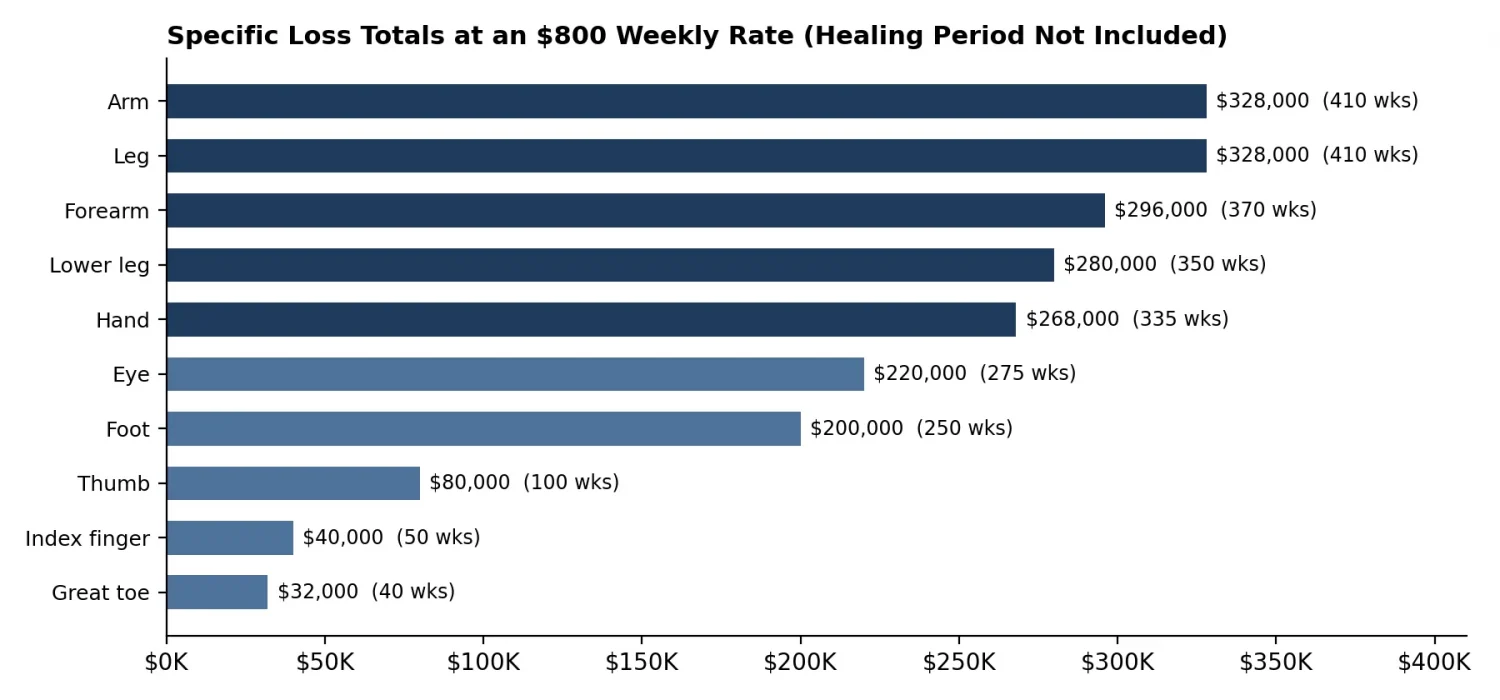
Illustration based on the weeks listed in 77 P.S. § 513. Actual awards depend on your compensation rate and injury.
Hearing Loss and Disfigurement Claims
Hearing loss claims follow their own formula. The percentage of hearing impairment, measured by audiogram, is multiplied by 260 weeks for loss in both ears. Impairment of 10 percent or less pays nothing, while impairment of 75 percent or more is treated as complete. For loss caused by long-term workplace noise, you must file the claim within three years of the last exposure.
Disfigurement claims cover serious, permanent scarring of the head, neck, or face that is not usually expected in the job. A workers’ compensation judge views the scar in person and awards up to 275 weeks based on its appearance.
How Specific Loss Works With Other Benefits
Specific loss is a separate benefit, but it interacts with the rest of your claim. You can still receive medical benefits for the injury. In most cases, you receive disability benefits during the healing period and then move into specific loss payments, rather than collecting both for the same injury at once. Your claim usually begins with a Notice of Compensation Payable, and our article on what an NCP really means for your case explains why its injury description matters for a later specific loss claim.
Hand and finger losses are common in construction, manufacturing, and agriculture throughout South Central Pennsylvania. Our Pennsylvania construction worker injury lawyers handle these claims regularly.
Has the insurer said your injury does not count as a specific loss? Mooney Law has helped injured workers across Pennsylvania and Maryland recover benefits for permanent injuries. Call 717-632-4656 for a free consultation.
Frequently Asked Questions About PA Specific Loss Benefits
Can I get specific loss benefits if I went back to work?
Yes. Specific loss benefits compensate for the permanent loss itself, not for lost wages. A worker who returns to the same job, or never misses a day, can still qualify if the loss or loss of use is permanent.
How much is a specific loss payment in Pennsylvania?
The weekly rate is two-thirds of your average weekly wage, but it cannot be less than half of the maximum rate or more than the maximum for your year of injury. For 2026 injuries, that range is $697 to $1,394 per week. Multiply the weekly rate by the number of weeks the Act assigns to the body part.
Does a shoulder, knee, or back injury qualify for specific loss?
The schedule does not list shoulders, knees, hips, or the back as separate body parts. A shoulder or knee injury may still support a claim if it causes permanent loss of use of the whole arm or leg. Back and spine injuries are generally handled through wage-loss benefits instead.
Can I receive specific loss and total disability benefits at the same time?
Generally, not for the same injury. A worker usually receives disability benefits during the healing period and then transitions to specific loss payments. If separate injuries from the same accident keep you totally disabled, the specific loss period typically begins after that disability ends.
Can a specific loss claim be settled as a lump sum?
Yes. Many specific loss claims are resolved through a negotiated lump sum, which a workers’ compensation judge must approve. Because the value is tied to a set number of weeks, confirm the correct rate and body part before agreeing to any number.
What Happens When You Call Mooney Law
When you call 717-632-4656, our team will ask about your injury, the affected body part, the treatment you have received, and whether the insurer has accepted your claim. We will schedule a free consultation with a workers’ compensation attorney, who will review your medical records and wage information and explain whether a specific loss claim is likely and roughly what it could be worth. We handle workers’ compensation cases on a contingency fee basis.
Talk to a Pennsylvania Workers’ Comp Lawyer About Specific Loss
Specific loss benefits can be one of the largest parts of a workers’ compensation claim, but only if the injury is properly documented and the correct rate is applied. Do not accept an insurer’s conclusion that you have only a partial loss without a second opinion. Many workers also believe myths about what they can collect, and our article on the biggest myths workers believe about compensation benefits clears up several.
Call 717-632-4656 for a free consultation with Mooney Law.